
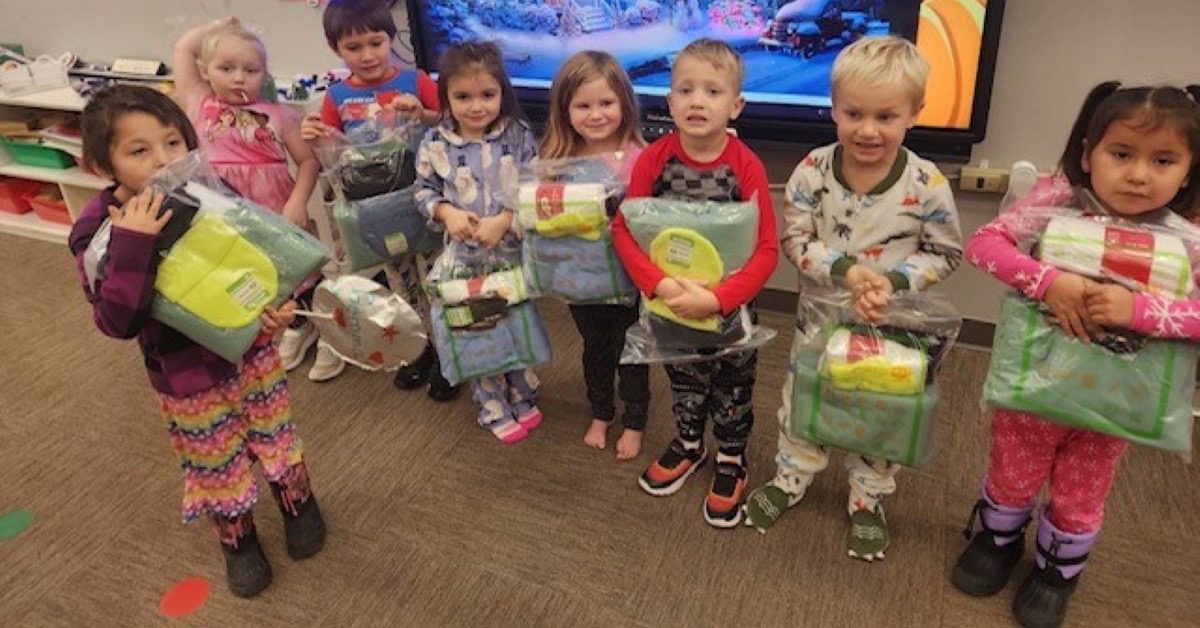
Running Strong’s Winter Warmth programs — including our winter clothing distribution — are vital lifelines that meet urgent needs and uphold dignity across Indian Country during the harshest months of the year.
Each year, Running Strong distributes essential winter gear, thousands of new coats, and winter kits (hats, gloves, scarves, blankets, and socks) to Native children, elders, and families nationwide, helping them face sub-zero temperatures safely.
These efforts go far beyond immediate relief: they provide warmth, security, and peace of mind for families living in regions where wind chills can dip to -40°F and where economic hardship makes heating costs or new clothing unattainable.
Today, as inflation and utility prices rise, these programs continue to fill a critical gap—ensuring Native families don’t have to choose between heat, food, or safety, and can instead focus on thriving through the winter season.
Last winter, Running Strong distributed 4,002 adult coats and 3,000 adult winter kits, 2,004 child coats and 3,000 child winter kits, 900 infant coats, and 5,044 winter socks.
Following the distributions, our grateful partners in Arizona, California, Colorado, Kansas, Minnesota, Nevada, Oklahoma, South Dakota, Utah, Wisconsin, and elsewhere expressed the great impact a warm winter coat makes in the lives of children and youth, and their families as a whole.
“Running Strong in-kind donations of warm coats directly addresses the harsh realities of Minnesota winters and the financial burdens they place on families,” reported Theresa Halvorson-Lee of the Division of Indian Work in St. Paul.
“Many families in our community face difficult decisions during this season, often choosing between essentials like heating, food, or clothing. A warm coat is not just a piece of clothing — it’s a shield against the biting cold and a lifeline for children walking to school or playing outside.”
At the Menominee Indian School District (MISD) in Keshena, Wisconsin, nutritional services and education coordinator Tina Waupoose reported that following the distribution of 144 child-size and 132 adult-size coats, along with 300 pairs of winter socks, “We had a lot of success. We had enough jackets to send to the whole community.”
Tina explained, “We come from a poverty reservation (the Menominee Indian Reservation in the northeastern region of the state). Many of our families have single working parents. Sometimes, they need to provide food before they can get jackets or warm socks for all the kids in the household.”
She also reported hearing numerous comments such as “This is amazing,” one said, “with tears in their eyes,” and “Thank you so much, it means a lot to us.”
Paula Walker, CEO of the Boys and Girls Club of the Iowa Tribe of Kansas and Nebraska in White Cloud, Kansas, reported following their distribution last December of 204 adult coats and 220 child coats, along with 350 winter kits, that “The kids were all so excited to get one and we gave them out when we had our Christmas event, perfect in time for the holidays and right before all the cold weather got here.
“We have a lot of low-income families in our area, and it just helps them out so much. We partner with social services here, and a lot of the kids that are in the system had no coats, so it all worked out perfect.
“One of our littles said, ‘Now I can be ready to go out and play in the snow when it gets here because these coats are that warm.’”
This year, our goal is to distribute 3,000 child coats, 3,000 adult coats, 1,000 infant coats, 3,000 adult winter kits (hat, gloves, scarf, and blanket), 3,000 child winter kits, and 5,000 winter socks to tribal communities across the nation.
This fall we received requests from 16 partners throughout Indian Country from Maryland to Montana, including Biiluuke Strong in Garryowen, Montana, which has asked for 408 child coats, 406 adult coats, and 400 winter kits.
Executive Director Ember Singer told us, “Our communities are all under the national poverty level, with many homes without water, electricity, some without heating during winter months, and without cooling during summer months. Many of our children participate in the free lunch programs at the local schools and qualify for free lunch during regular school sessions.”
Regarding the need for winter coats on the Crow Nation, she added, “Coats are a much-needed resource for children in our communities.
“The majority of the homes are heated only with the aid of LIHEAP (Low Income Home Energy Assistance Program), and those without heat in the winter need extra ways to keep their children warm.
“They sleep in their coats when the weather is freezing to save on heating costs or save firewood. They want to be warm on the bus to and from school.
“Coats allow them the comfort of warmth in the winter months.
“Jobs are scarce and repairs to old coats are worn out or taped with duct tape.
“When Running Strong sends winter coats, the children in our communities are joyful and excited. Many of them don’t receive new items very often or items that fit properly.
“Receiving coats would mean the world to the kids that receive them, and to the parent struggling to find ways to keep their children warm in the winter due to the poverty and lack of resources on the reservation.”