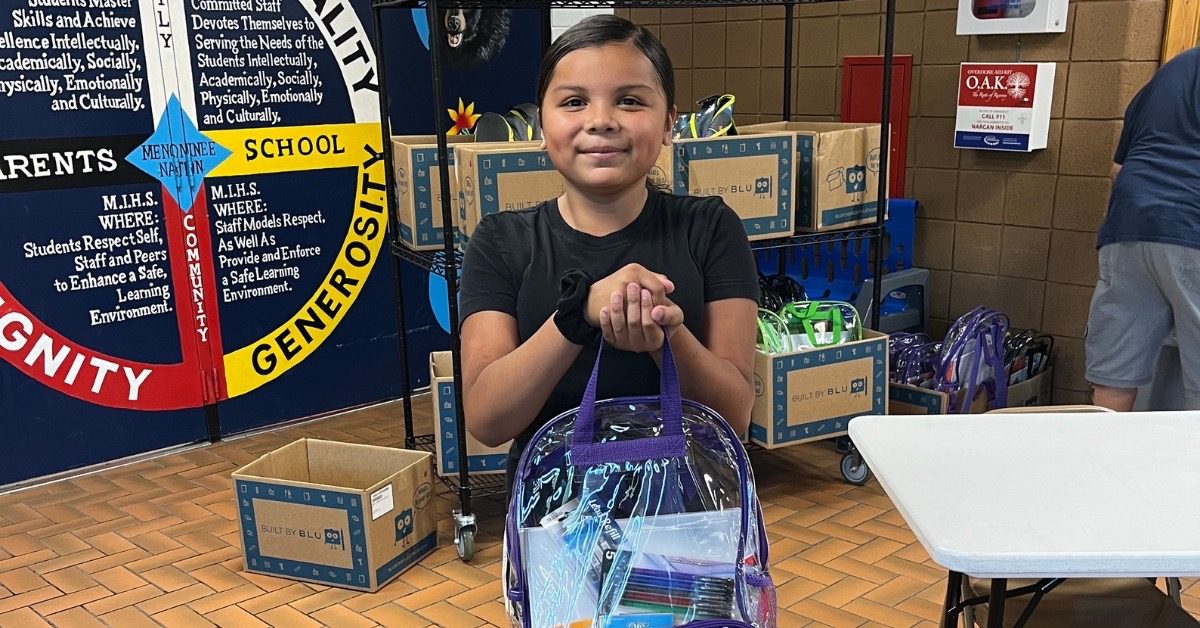
Running Strong for American Indian Youth® is supplying Oyate Ta Kola Ku, our community center in Kyle, South Dakota, with 3,000 brand-new backpacks and K-12 school supplies. We are getting school supplies into the hands of students on Pine Ridge through Oyate Ta Kola Ku, the Center our community already knows and uses.
- 1,000 elementary backpacks, filled with grade-appropriate supplies
- 1,000 junior high backpacks, filled with grade-appropriate supplies
- 1,000 high school backpacks, filled with grade-appropriate supplies
Each backpack is packed with the essentials students use — scissors, rulers, pencils and sharpeners, glue, pens, and notebooks — matched to each age group, with higher-grade kits built for older students’ coursework. Clear backpacks are available.
Why the need exists
The need on Pine Ridge did not appear on its own. It was built — deliberately — over more than a century and a half of federal policy designed to take Lakota land and erase Lakota people.
The 1851 and 1868 Treaties of Fort Laramie recognized the Great Sioux Reservation, including the He Sápa (Black Hills) sacred to the Lakota, as Lakota land. The United States broke that promise within a decade. When Custer’s 1874 expedition confirmed gold in the Black Hills, the government let miners flood in and then seized the Hills outright in 1877 — a taking the U.S. Supreme Court itself would later rule illegal (Smithsonian, National Museum of the American Indian). The Army made war on the people who resisted, even after the Lakota and Cheyenne victory at the Battle of the Little Bighorn in 1876, and deliberately destroyed the buffalo herds the Lakota lived on, using starvation to force families onto agency rolls. Crazy Horse was killed in custody in 1877. Sitting Bull was killed in 1890. That same year, the Army massacred nearly 300 Lakota men, women, and children at Wounded Knee — on the Pine Ridge Reservation itself.
What followed was not peace but genocide carried out through policy. The Great Sioux Reservation was carved into smaller pieces, confining the Oglala Lakota to the Pine Ridge Agency, where families were assigned enrollment numbers like cattle. Children were taken from their homes to boarding schools built to “kill the Indian, save the man” — forbidden to speak Lakota, stripped of their names, hair, and culture, abused and murdered (Native American Boarding School Healing Coalition). Allotment broke up communal land, and the Indian Relocation Act pushed families off the reservation and into cities. Each policy shared one aim: to eliminate Native people as Native people. This was genocide — the deliberate destruction of a people and their way of life — and the machinery that carried it out was never fully dismantled. Its effects still shape daily life on Pine Ridge.
Those effects are measurable. The median household income on the Pine Ridge Reservation is $36,424 — less than half the U.S. median — and 52.9% of children live below the poverty line, nearly four times the national rate (Running Strong, 2023 Census data). Native students nationwide are far more likely than their peers to attend high-poverty, under-funded schools, and far less likely to graduate (National Indian Education Association). This is the foundation beneath a family that can’t afford a new backpack: not a budgeting problem, but the direct inheritance of policy built to leave Lakota people with as little as possible.
A backpack does not undo that history. It removes one fixed cost from families still carrying its weight, so a student can start the school year with what the classroom expects.
In their words
Our team sees the need directly, every year:
“Living on a reservation, we have a lot of families with kids that don’t have the funds to get new backpacks every year, so this helps out so much. School supplies alone are quite expensive, so being able to get new bags every year is not always possible. We also have grandparents taking care of their grandkids. We have seen throughout the years how many struggle with deciding whether to get food, school supplies, or pay a bill.”
– Distribution Volunteer
The tradeoff — food, supplies, or a bill — is the one this program is built to ease. So is the point about grandparents raising grandchildren, which is common on Pine Ridge, where many households run on fixed incomes.
School Support at Oyate Ta Kola Ku
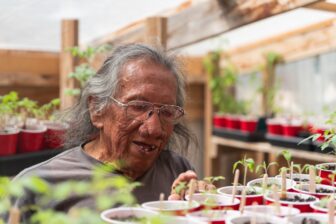
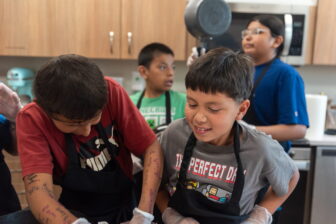
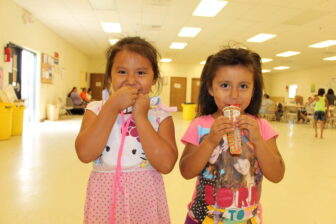
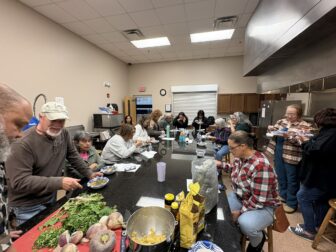
Routing backpack support through Oyate Ta Kola Ku puts it inside a place Pine Ridge families already use — our center that also runs youth and cultural programming, a garden, and a café. A family picking up a backpack is connecting with the same center they are familiar with, and the supplies stay available across the school year rather than for a single afternoon.
This fall, 3,000 Pine Ridge students will start school with a backpack and the supplies they need, available at their own community center for as long as the school year runs.
To help keep Oyate Ta Kola Ku stocked with backpacks and supplies for Pine Ridge students, give at Running Strong.