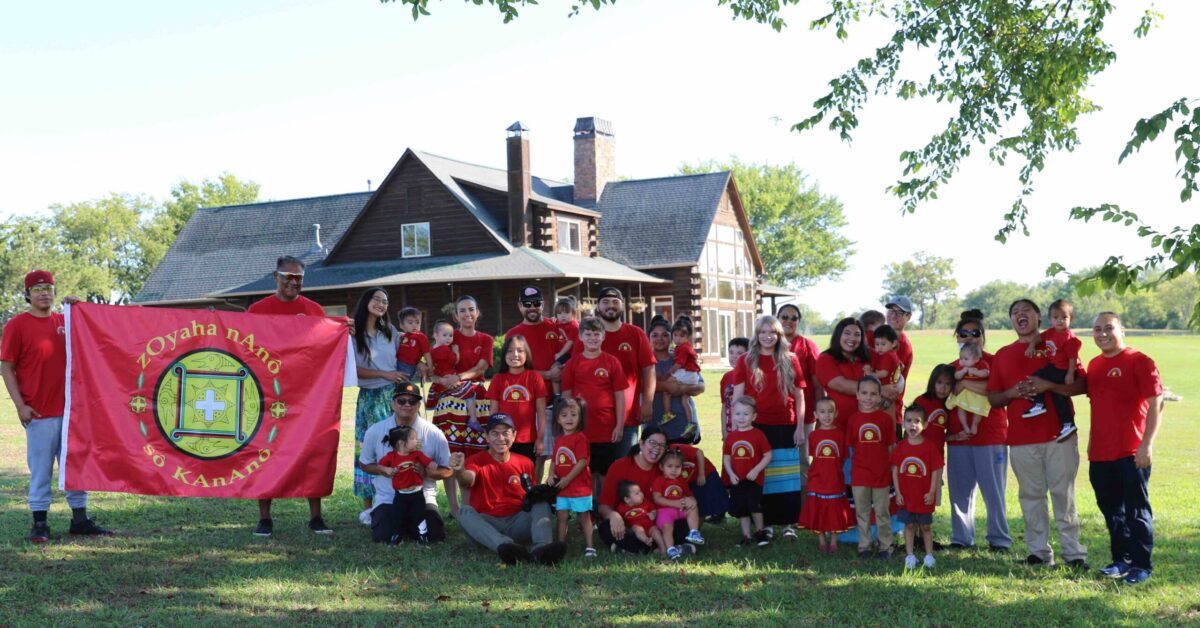
The Yuchi Language Project (YLP) in Sapulpa, Oklahoma, was founded in 1994, they received their first grant from Running Strong for American Indian Youth in 1996, with this year marking our 30 year partnership to preserve, protect and promote Yuchi Language.
The Yuchi Language Project’s mission is “to keep alive the rich heritage of the Yuchi people by creating new young speakers of our unique language through ‘breath-to-breath’ immersion with fluent speakers and children,” says YLP director of programs Halay Turning Heart. Using a wholistic teaching model the Yuchi Language Project consists of Language Teacher development, community language programs, and an immersion school to ensure all ages and abilities have the opportunity to engage and share in Yuchi language learning.
“Our partnership with Running Strong began in 1996,” notes Halay. “We continue to work to reclaim our mother tongue and the education of our children, in order to create new young speakers and carry on the vision of our elders.”
The Yuchi people originally lived in the Eastern Tennessee River Valley, with their own distinct culture, language and traditions. Due to colonization, forced relocation and federal Indian Policy of the 19th century, the Yuchi people were forced to relocate into modern day Oklahoma, and unfairly grouped with the Muscogee Nation when the reservation system was put in place.
Though they are separated from their homeland and have been denied federal recognition of their own, they have maintained their cultural ways and continue to practice their traditions. The Yuchi Language Project works not only to protect their language but also to promote a unique cultural identity and revitalize cultural traditions.
Yuchi is an incredibly unique language considered as a ‘language isolate’, meaning a language that has no demonstrable genealogical relationship with any other language.
Beginning with approximately ten fluent speakers, tribal members formed the Yuchi Language Project in an effort to preserve the language and pass it on to their children.
Over the decades, with support from Running Strong, the Project has produced recordings of elders speaking the language, archived words in writing and created different types of teaching materials.
In efforts to teach the language, they facilitate children’s immersion programs, master-apprentice teams, and language camps. Fluent elders have held classes on a daily basis to share the language breath-to-breath.
On December 23, 2012, one of the last male fluent speakers of the Yuchi language, Henry K’asA Washburn, passed away at the age of 88. Henry was the only individual able to speak the male version of the Yuchi language fluently. In the Yuchi language, men and women use different pronouns, noun classes, and family terms; therefore, he was the only person able to teach young men their corresponding version of the language, including teaching Yuchi men a significant ceremonial funeral procedure that only Yuchi men can perform.
Throughout his life, Henry was incredibly dedicated to preserving his Native language and culture, volunteering his time to the project every single day in the final years of his life to ensure the proliferation of the Yuchi language.
Following his passing, in was noted that while he would certainly be missed by many, but his impact will be felt for generations.
The Yuchi language was described by The Washington Post in 2007 as being “on the brink of extinction”, as there were only four fluent Yuchi speakers by 2013, and by December 2017, that number was down to just three.
In 2017, Yuchi Language Project executive director Richard Grounds, Ph.D., told us that “We are working feverishly against the clock to keep alive our unique Yuchi language by linking our youth with the remaining Elder speakers who are all in their 90s now.
“Our language is critical to our tribal ceremonies and all our traditional knowledge about medicines, history and cultural practices.
“By connecting our youth to their culture through the language they become stronger and more grounded in their identity as Native youth.”
He explained that the Yuchi Language Project is itself the embodiment of the vision of Yuchi Elders “as we work to breathe new life into the Yuchi language and culture.
“We believe the greatest challenge facing the Yuchi community is keeping alive our unique language for future generations.”
The Yuchi Language Project, with support from Running Strong, is making steady progress toward overcoming that challenge. Through their programming they have produced a dozen speakers (as of 2017) who are competent to teach the language and who are active in bringing the language back into three active Yuchi ceremonial grounds.
In 2019, Running Strong emphasized that among our core missions, is to support programs that preserve and revitalize languages and culture like the Yuchi Language Project.
Thanks to the supporters of Running Strong, we have been able to support the organization’s language immersion program since 1996 providing grant funding for class supplies, payroll for instructional staff, Elder honoraria and apprentice stipends.
“The grant has been used to directly facilitate the implementation of an effective daily immersion program for children and youth,” reported Halay.
“It is our practice to give our Yuchi students tribal names which connects them to their identity in ways they would not otherwise have access, she explained. “One of our new learners is only age 3 and was recently given a Yuchi name for the first time — gOdaba, which means strong man.
“He is very proud of his name and uses it all the time. Every morning in our opening routine we ask him “wEg@nzATE?” and he answers confidently: “gOdaba A zATE!” (my name is gOdaba). His three older siblings also received Yuchi names and the program has had a big impact on their family this year. Prior to their enrollment they didn’t have much interaction with the Yuchi language or culture.
“We are proud of all of our students and the opportunity to boost their self-esteem through the Yuchi language.”
Halay also reported that year that the YLP continues to work with the last remaining fully fluent elder, gOlaha (Grandmother) Maxine Barnett, then 93, while working to expand language project members’ own skills as speakers and instructors so that they can successfully carry on the Yuchi language work.
In 2022, Halay reported an historic accomplishment to us: “A new cohort of approximately 10 Yuchi children are speaking their mother tongue for the first time in 100 years.”
Among them was gOdAanE, a 3rd grader in the Yuchi Immersion School who “in only a few short months has become a conversational speaker of the language!”
Halay had told us that the boy had transferred to the immersion school from public school, where his Yuchi language was criticized and made fun of.
“He is now a model speaker for the other students and has become a huge Yuchi language advocate,” she reported, adding, “We are overjoyed with his progress and the ability to offer decolonized education to our Yuchi children.”
Halay also shared some big news about the Organization being featured on All Things Considered on National Public Radio in September, “A family that speaks Yuchi at home faces pushback from outsiders and tribal members.”
In her report, Laurel Morales, a freelance reporter for NPR, noted that Halay’s first language is English, but her father wanted her to be fluent in Yuchi so when she was a child he introduced her to Yuchi elders “who became her best friends.”
Halay commented that she would try to speak as much as she could, making her own sentences.
“And I would try things out, then ask her, (speaking Yuchi) – ‘is this right?’ And if she couldn’t understand me, I knew it wasn’t right.
“It’s like becoming an elder before your time.”
In June of this year, reporting for the YLP, Shelby Jackson stated that “Rooted in the understanding that our language is a living presence… the YLP operates the only full-day Yuchi language immersion school in existence, currently serving 30 students from preschool through fifth grade.”
She explained that “through daily immersion in Yuchi language woven into every subject—including stories, land-based learning, culture, math, literacy, science, art, music, and physical education—our young learners are growing into the future leaders of our community.
“They will one day be able to conduct ceremonies, prepare traditional medicines, tell stories, and offer prayers in Yuchi, embodying the worldview and cultural knowledge of their ancestors as fluent speakers.”
With grant funding made possible by the supporters of Running Strong, Shelby reported that the majority of funds were used to support personnel costs associated with delivering Yuchi language instruction, including instructor compensation and payroll taxes.
Funding also supported administrative and accounting services, transportation expenses, educational and classroom supplies, printing and office supplies, and facility-related costs such as rent, utilities, and equipment maintenance.
“These investments helped sustain daily Yuchi language immersion programming and provided students with the instructional resources, learning environment, and operational support necessary to advance language acquisition and cultural learning.”
Accomplishments for 2026
- Provided full-day Yuchi language immersion education to approximately 30 students in preschool through fifth grade.
- Supported Yuchi language learning among parents and caregivers through ongoing adult language instruction and family engagement activities.
- Continued development and refinement of culturally grounded Yuchi language curriculum and educational materials.
- Strengthened opportunities for intergenerational language transmission through activities involving children, families, Elders, and fluent speakers.
- Advanced the long-term goal of creating new generations of Yuchi speakers and preserving Yuchi language and cultural knowledge for future generations.
The parents of the students in the Yuchi Immersion School are grateful for the opportunity to send their children to the school, with one parent telling Shelby: “Being part of the program has made everything in our daughter’s life organically better. She is achieving beyond what we had even imagined.”
As one whose life has been changed for the better through the program, wA’yû Keland Bearpaw told us: “We dropped down to one speaker … and from there, we’ve been able to create at least 40 to 60 speakers now.
“Our kids are the first generation to speak it from birth. That’s how we rebuild — by starting young, in the home, every day.”
And to the supporters of Running Strong, Shelby says:
“We are deeply grateful for Running Strong’s support of this work.
“The Yuchi language was once on the verge of extinction.
“Today, because of decades of community-led language revitalization efforts, YLP is supporting the first cohort of children in more than a century who are growing up as first-language Yuchi speakers.
“This represents a historic milestone not only for the Yuchi people, but for Indigenous language revitalization efforts across North America.
“Your investment helps ensure that Yuchi language, culture, and identity continue to live in the voices of future generations.
“Our vision is for today’s children to grow up empowered to say in our language, “yUdjEhanAnô sôKAnAnô” — “We, Yuchi people, we are still here.”